
Enterprise Value Formula: How to Calculate & Use It 2026


Authored by
Varun
Date Released
16 Jul, 2026
When it comes to estimating what a publicly traded company is truly worth, understanding the enterprise value formula becomes essential. Buyers usually use it as a first step to decide how much they should offer during an acquisition, whereas sellers may rely on it to evaluate potential returns from a sale. In contrast to market capitalization alone, the enterprise value formula takes into account a company's entire financial position and offers a complete valuation, helping investors, business owners, and dealmakers make better-informed transaction decisions with more confidence.
What Is Enterprise Value? Definition & Meaning
Enterprise value meaning goes beyond a company's share price. It shows what the whole business is worth, including its debt and cash. The enterprise value formula represents market capitalisation plus total debt, minus cash and cash equivalents.
Enterprise value meaning in simple terms
What is enterprise value, in simple terms? The answer to this: it is not just the shares owned by investors; it is the estimated value of a company's entire operating business.
The enterprise value formula starts with market capitalisation, then adds debt and other claims, and finally it subtracts cash. Basically, it shows what the business costs for everyone involved.
Table of Contents
Enterprise value vs market capitalization: key difference
| Enterprise Value vs. Market Cap | Enterprise value | Market capitalization |
|---|---|---|
| Meaning | Shows the total value of a company's operating business. | Shows the total market value of its outstanding shares. |
| Useful For | Comparing companies with different debt levels and acquisitions. | Understanding a company's stock-market size. |
| Debt | Includes the company's debt commitments. | Does not involve any debt. |
| Cash | Available cash reduces enterprise value. | Cash does not directly impact market capitalization. |
| Formula | Market cap plus debt, minus cash and other cash equivalents. | Share price multiplied by the remaining shares. |
Why Enterprise Value Matters in Business Valuation
Enterprise value matters because it shows the entire business value, as it includes equity, debt, and available cash, thereby presenting a wider picture than market capitalization alone.
With the help of the enterprise value formula, a company can estimate what a buyer will willingly pay to acquire a company. It allows fair company comparisons by comparing different debt levels, cash reserves, and capital structures.
Analysts get support in valuing enterprise ratios with measures such as EV/EBITDA and EV/Sales. Business valuation and enterprise value help a buyer identify whether a company is overvalued or undervalued for making better investment decisions.
Enterprise Value Formula: Complete Breakdown
The EV formula indicates how much a buyer may effectively pay for acquiring a company's core business. By learning how to calculate enterprise value, an investor gets a full basis for comparing companies, assessing acquisitions, and understanding overall value beyond the stock price alone.
The standard enterprise value formula explained
The standard EV formula is:
EV = Market Capitalization + Total Debt + Preferred Stock + Minority Interest − Cash and Cash Equivalents
EV – Enterprise Value
Market capitalization – It captures the value of ordinary shares.
Total debt – It covers short-term and long-term borrowings.
Preferred stock – It includes senior ownership claims.
Minority interest – It reflects outside ownership in consolidated subsidiaries.
Cash and cash equivalents – These are deducted because they are readily available to reduce the buyer's effective cost.
These enterprise value formula components together calculate enterprise value more completely than a share price alone, especially during acquisitions or cross-company valuation comparisons and investment analysis.
Key components of the enterprise value formula
Market capitalization: Shows the market value of common equity and is calculated by multiplying the share price by the outstanding shares. It acts as the starting point of the enterprise value calculation.
Total debt: Includes borrowings based on short-term and long-term interest. It is added because an acquirer takes responsibility for these obligations.
Preferred stock: Included because preferred stockholders may require repayment during a transaction, as it holds claims ahead of common shareholders.
Minority interest: Represents the part of a consolidated subsidiary that the parent company usually does not own. It is added in case the subsidiary's full operating earnings are included in valuation measures.
Cash and cash equivalents: These liquid funds are subtracted because a buyer gains access to that cash and can use it to repay debt or offset part of the acquisition cost.
Market capitalization in the EV formula
The market cap enterprise value formula is the equity basis of the enterprise value formula. It is determined by multiplying a company's share price by the number of outstanding shares. It shows what the stock market assigns to common shareholders.
However, market cap reflects only equity value, and it does not show the debt a buyer owes or the cash gained from the business. That is why it serves as the starting point, not the valuation.
Total debt & preferred stock in EV calculation
Total debt in the enterprise value calculation covers short-term and long-term interest-based liabilities. It is usually added because an acquirer assumes that ignoring these liabilities would understate the company's effective purchase cost.
Also, preferred stock is added to the enterprise value formula because preferred holders receive priority over common shareholders and often have fixed dividend or redemption claims.
Together, debt and preferred stock highlight the amount of value that belongs to capital providers above ordinary shareholders.
Cash & cash equivalents — why we subtract them
Cash and cash equivalents are subtracted from the enterprise value calculation because they reduce the cost of acquiring a company.
Once the deal gets closed, the buyer gets control of those funds and can use them to repay debt, fund operations, or offset the purchase price. The deduction covers cash and assets that can quickly become cash.
Reserved cash or funds that are inaccessible for general use may demand separate treatment because a buyer cannot freely use them.
Enterprise Value vs Equity Value: Key Differences
1. Value covered: Enterprise value measures the value covered by shareholders, lenders, and other capital providers, whereas equity value only showcases the portion belonging to common shareholders.
2. Calculation: The enterprise value formula includes net debt, preferred stock, and minority interest. On the contrary, equity value is the share price multiplied by the outstanding common shares.
3. Valuation use: While performing enterprise value vs equity value analysis, enterprise value supports capital-structure-independent company comparisons, while equity value is useful for computing shareholder ownership and per-share value. So, EV vs equity value depends on who makes the claim.
What is equity value & how is it calculated?
Equity value means the overall market worth of a company's common shares. It shows the value that belongs specifically to its shareholders.
Step 1: Consider the company's actual share price.
Step 2: Then determine its diluted shares outstanding and include warrants and convertible securities if relevant.
Step 3: Apply: Equity Value = Share Price × Diluted Shares Outstanding
Step 4: Study the result very carefully.
In enterprise value vs equity value analysis, equity value covers shareholders only, whereas enterprise value also adds debt, cash, preferred stock, and minority interest.
Enterprise value to equity value bridge explained
The enterprise value to equity value bridge breaks down the value of business operations from the amount available to common shareholders.
Step 1: Begin with enterprise value, which reflects the company's operating value for all capital providers.
Step 2: Determine net debt by subtracting cash and cash equivalents from total debt. Subtract net debt because lenders hold this portion of the company's value.
Step 3: Subtract preferred stock, since preferred shareholders have a financial claim ahead of common shareholders.
Step 4: Deduct minority interest, which represents ownership in consolidated subsidiaries held by outside investors.
The remaining amount is the equity value. So, in an EV vs equity value comparison:
Equity Value = Enterprise Value − Net Debt − Preferred Stock − Minority Interest
When to use enterprise value vs equity value
1. Use enterprise value for the whole business: Choose EV for acquiring a whole business, an unlevered DCF, or when comparing companies with different debt levels.
2. Use equity value for shareholders: Choose equity value while calculating common shareholders' value, share prices, or returns after debt claims.
3. Match value with the purpose: In enterprise value vs equity value analysis, use EV while performing business valuation and equity value when making shareholder-focused decisions.
How to Calculate Enterprise Value: Step-by-Step
Let us understand how to calculate enterprise value with the help of four steps. It begins with the company's market value and then adjusts it for major financial claims and liquid resources.
The full enterprise value formula is:
EV = Market Capitalization + Total Debt + Preferred Stock + Minority Interest − Cash & Cash Equivalents
Step 1: Find the company's market capitalization
Market capitalization means the current market value of the company's outstanding shares. Calculate it by multiplying the latest share price by the total shares outstanding.
For instance, suppose a company has 20 million shares trading at ₹50 each; its market cap value is ₹1 billion.
When you calculate enterprise value using the enterprise value formula, this step is considered the starting point, but it only considers common shareholders' ownership and does not reflect any debt or available cash.
Step 2: Add total debt & minority interest
In step 2, calculate total debt enterprise value by adding short-term and long-term interest-based debt, because a buyer effectively takes on these obligations after acquiring a business.
Operating liabilities, such as day-to-day accounts payable, are generally not taken as debt in the enterprise value formula. Add minority interest when the company presents complete financial results of a subsidiary that it does not completely hold.
Step 3: Add preferred stock
In step 3, to calculate enterprise value, add preferred stock because preferred shareholders hold a higher claim on the company's assets and earnings compared to common shareholders.
Calculate preferred stock using the preferred stock enterprise value formula. As these are defined as equity, they sometimes behave like debt by paying fixed dividends and maintaining repayment priority.
An acquirer might continue honoring these claims; in that case, excluding preferred stock will understate the company's effective acquisition value.
Step 4: Subtract cash & cash equivalents
In this last step of how to calculate enterprise value, cash and cash equivalents are deducted because a buyer gains control of all such funds after the acquisition. The acquirer may use cash to repay borrowings, finance operations, or offset some of the purchase price.
Cash enterprise value formula components include highly liquid short-term investments, like treasury bills and marketable securities. However, restricted cash may require separate treatment, as it is not freely available for general use.
Enterprise value calculation example (with numbers)
Let's take an enterprise value calculation example. A company has a market capitalization of ₹500 crore, total debt of ₹120 crore, preferred stock of ₹20 crore, minority interest of ₹10 crore, and cash and cash equivalents of ₹50 crore.
Enterprise value formula example:
EV = 500 + 120 + 20 + 10 − 50
EV = ₹600 Cr
The outcome is higher than the market capitalization because the financial obligations added exceed the company's available cash.
Enterprise Value Multiples & How They Are Used
Enterprise value multiples mean comparing a company's total operating value against financial measures such as revenue, EBIT, or EBITDA. Since the enterprise value formula adds debt and deducts cash, using these multiples helps analysts compare companies with different financing structures more accurately. Enterprise value multiples are commonly used in business valuation, acquisitions, and peer analysis.
EV/EBITDA multiple — most commonly used
The EV/EBITDA multiple divides enterprise value by EBITDA — earnings before interest, tax, depreciation, and amortization. It's commonly used because it reduces the impact of financing decisions, tax rates, and non-cash depreciation expenses.
Analysts must compare it clearly with industry peers and historical averages. A low enterprise value multiple might indicate undervaluation, but it may also point to weaker growth, reduced earnings, or greater business risk.
EV/Revenue multiple — when to use it
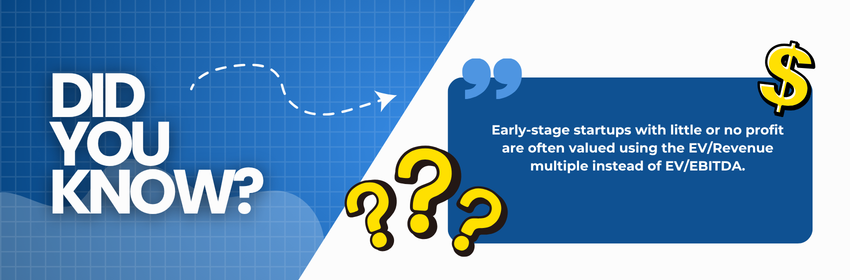
The EV/Revenue multiple compares enterprise value with total sales. It is used for loss-making companies whose EBITDA and EBIT are negative, or during early-stage or high-growth periods.
However, revenue alone does not indicate profitability. Companies with similar sales might have very different operating costs, margins, and growth potential, so this multiple requires careful evaluation.
EV/EBIT multiple — explained
The EV/EBIT multiple divides enterprise value by operating profit after depreciation and amortization. It provides a clean valuation for capital-intensive companies, as it considers the cost of long-term assets. But different depreciation methods may still affect company comparisons.
How enterprise value multiples compare companies
Enterprise value multiples reduce errors caused by differences in debt and cash levels. Analysts must compare businesses in the same industry while taking into account growth, profitability, risk, and accounting policies. The enterprise value formula must also be applied regularly, as no single multiple gives a complete valuation.
Where Is the Enterprise Value Formula Used in Finance?
When analysts want to measure the total value of a company's operating business instead of only its shares, the enterprise value formula is used.
The most common uses of enterprise value include mergers and acquisitions, leveraged buyouts, DCF analysis, financial modeling, investment banking, and equity research. So, enterprise value is mainly used in situations where debt, cash, and the claims of different capital providers impact the company's real value.
Enterprise value in M&A deals & acquisitions
M&A professionals use the enterprise value formula as it helps calculate the effective cost of buying a target company. It starts with equity value, then adds debt, preferred stock, and minority interest, and finally subtracts available cash. Here, debt is added because the buyer may have to repay it, while cash lowers the effective purchase cost.
Therefore, enterprise value acquisition analysis becomes more useful than relying only on market capitalization. It allows acquirers to compare potential targets with different debt levels and cash reserves and negotiate transaction prices — understanding what they are actually paying for the operating business.
Enterprise value in leveraged buyouts (LBOs)
In an enterprise value LBO model, private equity investors usually apply an entry EV/EBITDA multiple to determine the target company's purchase value. They then determine how much of the transaction can be funded through debt and to what extent equity must be invested.
The enterprise value formula also supports exit-value calculations. Investors typically forecast EBITDA at the end of the holding period and use an estimated exit multiple. After subtracting the remaining debt, analysts can predict equity proceeds and potential returns. Hence, enterprise value links acquisition pricing, debt repayment, operating growth, and investor returns within the LBO model.
Enterprise value in financial modeling & DCF
In enterprise value financial modeling, analysts forecast unlevered cash flow to the firm because it shows cash available to both lenders and shareholders. These future cash flows are discounted using the WACC and added to a terminal value.
Using the DCF approach, analysts calculate the value of the company's operating assets, then subtract debt and other non-equity claims and add excess cash to reach equity value. This approach keeps the projected cash flows, discount rate, and valuation results consistent for the same group of capital providers.
Enterprise value in investment banking & equity research
In investment banking analysis, EV is used for M&A valuation, comparable company analysis, precedent transactions, and deal valuation. Bankers usually use enterprise value multiples such as EV/EBITDA and EV/Revenue because they allow comparisons of businesses without focusing only on how each company is financed.
In equity research, the enterprise value formula plays a major role. Although research analysts ultimately estimate equity value and target share prices, they use EV multiples to compare operating performance across similar companies. This reveals whether a stock is relatively expensive or inexpensive after accounting for differences in debt and cash.
Common Mistakes in Calculating Enterprise Value
Common enterprise value formula mistakes include ignoring minority interest claims, relying entirely on book values, and deducting unavailable cash. Studying these common mistakes helps analysts build more accurate valuation multiples and DCF estimates.
Forgetting to include minority interest
One of the most common enterprise value mistakes is ignoring minority interest. Suppose a company owns 70% of a subsidiary but records 100% of that subsidiary's revenue, EBITDA, and assets in its financial statements — the remaining 30% still belongs to outside investors.
The minority interest adjustment adds the fair value of those outside holdings to EV. Without it, analysts would compare 100% of the subsidiary's earnings against an enterprise value covering only part of its ownership, which can understate valuation multiples and affect peer comparisons.
Using book value instead of market value of debt
The enterprise value formula ideally reflects the current market value of financing claims. Book debt records the accounting amount shown on the balance sheet, while market debt reflects what those obligations are worth under current interest rates, credit risk, and repayment terms.
The difference might be small for recently issued or short-term debt, but can become significant for long-term bonds, especially when market interest rates or the company's credit quality changes. Using book value without verifying actual market details may overstate or understate EV.
Incorrectly subtracting restricted cash
A common error is deducting every cash balance reported by the company. Restricted cash can be pledged as collateral, held as a reserve for debt payments, or legally earmarked for a specific purpose — meaning a buyer cannot freely use it to lower the acquisition cost.
Treating restricted cash like readily available cash can make EV too low. Analysts must review financial statements carefully and subtract only cash that is truly accessible.
Why Understanding the Enterprise Value Formula Matters for Your Business
The enterprise value formula showcases the entire business value after deducting debt and cash. It supports pricing and planning in business valuation, which is why enterprise value matters.
How enterprise value helps in business sale & exit planning
The enterprise value formula gives owners a practical starting point for estimating sale value. In business exit planning, enterprise value shows how buyer expectations, debt, cash, and performance impact negotiations and the final value of a proposal.
How to improve your company's enterprise value
To improve enterprise value, focus on profitability, cash flow, growth prospects, debt management, and recurring revenue. Since the enterprise value formula reflects market value, debt, and cash, stronger performance and lower risk can make a company more attractive to buyers.
Startup Financial Planning & Growth Insights
1
How Financial Modeling Helps Startups Grow Smarter
›
2
How FP&A Drives Better Financial Decisions
›
3
Accounting and Bookkeeping Services
›
4
How Corporate Finance Supports Sustainable Growth
›
5
What a Fractional CFO Really Does for Small Businesses
›
6
How Ratio Analysis Reveals Business Performance
›
7
How Variance Analysis Improves Financial Planning
›
Conclusion
The enterprise value formula offers a wider overview of a company's total valuation by considering key components such as market value, debt, and available cash. It helps buyers assess merger or acquisition costs and allows investors to compare businesses more accurately. But EV should not be used alone — integrating it with ratios such as EV/EBITDA and EV/Sales provides much more detailed insight into valuation, operating performance, and financial status. This helps investors and business owners make more informed and practical decisions.
Related Blogs



Common
Questions
Your Guide to Enterprise Value...
The enterprise value formula determines a company's total value by including market capitalization, short-term and long-term debt, and then subtracting cash and cash equivalents.
Enterprise value formula: EV = Market Capitalization + Total Debt − Cash and Cash Equivalents
Enterprise value highlights the actual worth of a business, including debt and cash, irrespective of its capital structure. Equity value shows the amount attributable to shareholders. In enterprise value vs equity value, enterprise value covers the whole company; equity value reflects shareholders' ownership.
Enterprise value tells you about a company's total worth, including debt and cash. The enterprise value formula helps in assessing acquisition possibilities more accurately.
A good EV/EBITDA ratio is generally lower than that of industry peers, below 8.0x, as it may indicate undervaluation. However, enterprise value multiples vary by sector, so investors should compare the EV/EBITDA ratio with similar companies before judging.
In M&A, enterprise value is used by buyers to estimate the overall cost of acquiring a business, including its debt and available cash. The enterprise value formula supports reasonable deal comparisons, while enterprise value acquisition analysis clearly shows the company's overall size, worth, and financial obligations.