
How to Switch to Accounting Outsourcing: Step-by-Step

Authored by
Varun
Date Released
08 Oct, 2026
Switching to accounting outsourcing does not merely mean transferring work responsibilities to an outsourced provider, nor should you expect every transition to go smoothly. For CPA firms, the bigger challenge comes with switching recurring tasks, information, systems, and review processes without compromising deadlines or the client's live project.
Whether you want to transfer your work from an exhausted in-house team to an outsourced accounting model or switch to an accounting outsourcing provider, the shift should be carefully planned. The main purpose is to create additional execution capacity, thereby keeping ownership, review standards, and client relationships clear.
This blog explains how to make that switch in seven practical steps.
Why CPA Firms Are Switching to Accounting Outsourcing
Capacity is usually the starting point. A firm may have the expertise to serve more clients, but recurring execution tasks, such as reconciliations, cleanups, report preparation, and month-end work, consume too much senior time.
Accounting outsourcing can add an execution layer beneath the firm's existing team rather than requiring the firm to build every level of capacity internally. That distinction matters: the firm can continue owning the client relationship and professional judgment while an extended team supports defined workflows.
TAG supports its clients and finance practitioners in maintaining their client relationship and judgment while adding execution capacity underneath them.
Table of Contents
Signs it's time to make the switch
Common signs to switch outsourcing accounting work include recurring capacity shortages, senior staff spending too much time on production work, inconsistent turnaround during busy periods, and growth being limited by the firm's ability to hire and train quickly enough.
Another sign is process dependency. If one person holds most of the knowledge about a client's close, reporting format, reconciliations, or recurring adjustments, the firm has a continuity problem even before outsourcing enters the conversation.
The question of when to outsource accounting is therefore not simply about workload. Rather, it is about whether the current delivery model can support the firm's next stage without compromising review quality or client service.
What changes (and what doesn't) after switching
A properly managed in-house vs. outsourced transition helps the firm maintain control of the engagement.
What changes is primarily where defined execution work happens and how capacity is organized. What remains the same is who owns the client's relationship, who reviews the work, what standards apply, and how final judgments are made.
The systems may not need to change either. An outsourced team can, depending on the engagement, operate within the firm's existing tools, templates, communication channels, and workflow rather than forcing the firm into an entirely separate operating environment.
TAG's preferred delivery model, for example, is fully embedded: working within the client's domain, email, time zone, and tools. A separate back-end model is also available where required.
Step 1: Assess Your Current Accounting Setup
Be sure to assess the accounting setup before outsourcing the work or switching the provider.
A strict current process audit should reveal how work moves from source documents via preparation, review, correction, and final delivery. Additionally, it should also define who controls each stage, what types of systems are involved, specific deadlines, and why work is regularly getting delayed.
The purpose is not to restructure the setup before outsourcing but to recognize the workflow well enough to know what you are transferring.
Identifying bottlenecks & pain points
Look for recurring accounting bottlenecks in-house rather than isolated problems. For example, reconciliations may regularly delay close, one manager may be reviewing too many client files, or the same corrections may appear month after month because the process is not documented clearly.
These pain points before outsourcing should influence what moves first. Transferring a poorly understood process without clearly understanding the underlying issue may move the bottleneck to another team.
Deciding what to keep in-house vs. outsource
The decision of what to outsource vs. keep in-house should be based on responsibility and workflow, and not a generic list of what tasks to outsource.
Recurring execution such as reconciliations, categorization, cleanups, catch-ups, reporting preparation, and month-end support may be suitable for an outsourced team. TAG's accounting capability includes these types of activities, extending through controller-level support.
Client ownership, firm-specific judgment, sensitive approvals, and other responsibilities the CPA firm wants to retain should remain clearly defined on its side.
The objective is not necessarily to outsource everything. It is to move the right work so internal professionals can spend more time where their judgment and client involvement matter most.
Step 2: Define Clear Goals for the Switch
Clear goals for switching to outsourcing make provider selection and implementation easier. Before approaching providers, define what would make the change successful. A firm trying to create capacity has different priorities from one trying to strengthen continuity or bring consistency to month-end delivery.
Clear outsourcing objectives make it easy to determine whether the new model is actually problem-solving or not.
Capacity, quality, continuity & cost - clarifying priorities
When defining your objectives, separate the priorities rather than treating them as one broad goal.
Capacity may mean supporting additional clients without continuously adding internal hires. Quality may mean reducing recurring corrections or standardizing deliverables. Continuity may mean reducing dependence on one internal employee. Cost may still be part of the decision, but it should be considered alongside the operating model and quality of delivery.
For TAG, the positioning is specifically around time and capacity rather than being the cheapest source of labor.
Step 3: Research & Select the Right Outsourcing Partner
How to select an outsourcing partner means understanding far more than only a list of tasks to be outsourced. An outsourcing partner may perform various accounting services such as bookkeeping, reconciliations, and reporting, but it is essential to verify whether it can work in your actual workflow and deliver work that a reviewer can use without adding another layer of management.
Additionally, when you research an accounting outsourcing provider, also evaluate how the provider handles onboarding, documentation, communication, review, security, and workload transition.
Evaluating experience, reviews & industry fit
When evaluating a provider's experience, check for evidence that the team has handled the type of work you plan to transfer.
Additionally, inquire about how they handle similar engagements, how work flows between preparers and reviewers, how process knowledge is documented, and how they handle situations when the usual team member is not present.
Provider references and accounting provider reviews may add context, but they should be used as support and not replace direct evaluation of actual work.
Check communication & working-style compatibility
Especially after implementation, communication compatibility with an outsourcing partner is a very important part for firms. Ensure projected response times, how questions are addressed, who takes care of day-to-day communication, which tasks require escalation, and when the provider should ask questions instead of making assumptions.
Even though an outsourced team is highly competent, it may still create unwanted stress if it does not align with the firm's communication and review style.
Step 4: Plan the Handoff & Prepare Your Team
A strong transition plan turns the handoff into a documented, repeatable process.
At first, avoid moving a large volume of work immediately. Start by documenting what is being transferred, who will control each stage, which files and systems are required, and how work will be reviewed before delivery.
Building a detailed transition timeline
A practical transition timeline for outsourcing accounting is usually based on work itself. So identify upcoming month-end dates, reporting deadlines, recurring client deliveries, system-access standards, and firms' internal review criteria. Then decide which workflows will move first and which should remain unchanged until the initial transition is stable.
The timeline should also allow space for questions and corrections. A handoff that looks efficient on paper can still expose undocumented exceptions once real files begin moving.
Documenting workflows, responsibilities & access
Outsourcing workflow documentation is one of the most important parts of the switch. Document deadlines, source files, templates, recurring adjustments, review procedures, escalation points, access requirements, and communication expectations. Clearly identify what the outsourced team prepares and what the CPA firm's team reviews or approves.
TAG's onboarding process specifically asks for client templates, style preferences, and a current or recent project, and TAG develops SOPs so delivery is not dependent on one person.
Prepare your in-house team for the change
Clarifying roles and responsibilities, and not simply declaring that specific work is being outsourced, is exactly what it means to prepare the team for an outsourcing switch.
Internal team training for outsourcing includes deciding which tasks will change, which tasks they still own, how they will interact with the new team, and where review responsibility falls.
This also helps prevent duplicated effort. If both teams continue performing the same task because ownership was never clearly reassigned, outsourcing adds work instead of removing it.
Step 5: Test the Partner Before Moving Live Work
A pilot lets the firm evaluate how the provider works before making the full switch. Instead of testing only whether the provider can technically complete a task, assess whether its output matches your review standards and whether the communication process works in practice.
What a good test project looks like
A strong pilot scope for accounting outsourcing should match the work you are expecting the provider to handle regularly, but a test should not put a live client at risk.
TAG uses a particularly controlled approach: a firm can send a project it has already completed, TAG redoes it, and the firm then compares the new output with its own previous work. That makes it possible to test the working relationship before introducing the provider into a live client workflow.
What to evaluate during the test
When you evaluate pilot outsourcing performance, look beyond whether the numbers are correct.
Review how well the provider followed instructions, whether the output matched your formatting and presentation expectations, how questions were handled, how clearly issues were communicated, and how much rework your internal reviewer had to perform.
TAG's own test approach explicitly focuses on quality, communication, and formatting rather than evaluating the numbers alone.
Step 6: Implement & Monitor the Switch
Once the pilot runs successfully, begin to implement outsourcing accounting with controlled steps. Transfer the decided workflows first, verify whether those responsibilities and access are working as expected, and later expand the scope when the delivery process becomes stable.
The objective is not to create a permanent "transition mode." It is to establish a repeatable working model in which both teams know what happens next without constant intervention.
Setting communication cadence & escalation paths
A defined communication cadence for outsourcing implementation keeps routine work routine.
Agree on how normal questions will be handled, when status updates occur, who the day-to-day contacts are, and which problems should be escalated immediately. The communication structure should be simple enough that the CPA firm's senior staff are not required to coordinate every handoff themselves.
Addressing early issues quickly
Some issues during an outsourcing switch are expected because documented processes do not record every exception in the document.
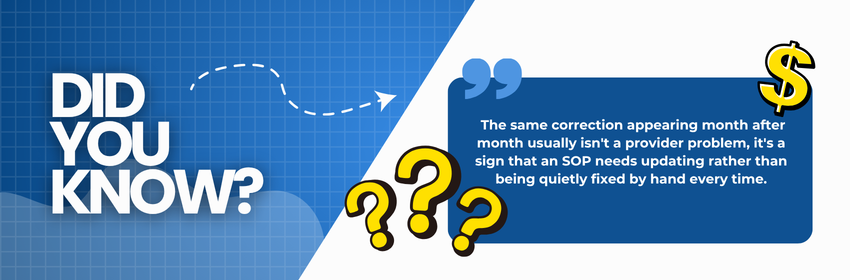
Hence, it is necessary to distinguish between an individualized correction and a recurring process issue. If the same issue occurs again, update the SOP or clarify the responsibility rather than manually correcting the output every time. However, early feedback should make the workflow much stronger and not simply fix the current file.
Step 7: Track KPIs & Continuously Improve
The appropriate KPIs to track outsourcing accounting must indicate whether outsourcing is improving the delivery model and not merely show that the work is being accomplished.
| KPI | What it measures |
|---|---|
| Turnaround | Time from handoff to review-ready delivery |
| Error Rate | Corrections or rework needed per deliverable |
| Client Satisfaction | Client feedback on delivery quality |
| Scalability | Ability to absorb workload changes without delays |
| Data Security | Access controls, reviews, and any security incidents |
| Cost | Overall cost impact of the engagement |
Continuously measuring outsourcing success allows firms to figure out when additional workflows can be switched to the outsourced team and where the process still requires modifications.
Common Mistakes When Switching to Accounting Outsourcing
Most transition problems come from how the switch is managed rather than from outsourcing itself.
Switching without a defined transition plan
A major outsourcing risk is identified when firms hand off tasks without documenting tasks, roles, deadlines, access, review points, or exceptions.
The provider may know what needs to be done but not how your firm expects it done. That difference creates rework and unnecessary questions.
Skipping the test phase
Skipping a pilot in accounting outsourcing cuts off an important opportunity for firms to understand how the provider actually functions.
A test on a previously completed project can reveal differences in quality, communication, formatting, and interpretation before they affect a live engagement.
Not preparing your team and workflows for the change
Preparing staff and clients for an outsourcing switch does not mean that every client requires a major change in how they communicate with the firm. Additionally, in an embedded or white-label setup, the client experience usually stays largely unchanged.
Without that clarity, the firm ends up with conflicting responsibilities, and the switch works against its own purpose.
Startup Financial Planning & Growth Insights
1
How Financial Modeling Helps Startups Grow Smarter
›
2
How FP&A Drives Better Financial Decisions
›
3
Accounting and Bookkeeping Services
›
4
How Corporate Finance Supports Sustainable Growth
›
5
What a Fractional CFO Really Does for Small Businesses
›
6
How Ratio Analysis Reveals Business Performance
›
7
How Variance Analysis Improves Financial Planning
›
Conclusion
Make the Switch Without Disrupting Client Delivery
The main objective of switching accounting outsourcing is to add reliable execution capacity by preserving the CPA firm's standards, review process, and client relationships.
TAG is an already-built finance function of full-time professionals, with coordinated delivery and SOP-based continuity, not a freelancer or staffing model.
Ready to test the fit? Send TAG a project you've already completed. We'll redo it so you can compare the results before committing to anything.
Related Blogs



Common
Questions
Your Guide to Switching to Outsourcing...
How long an outsourcing transition takes depends on the workflow, scale, systems, and documentation being transferred. A structured switch is more important than rushing the timeline.
Not always. In an embedded model, the outsourced team can work within the firm's existing systems, tools, and workflows, whereas the CPA firm continues to own the client relationship.
Unclear transitions, such as poorly defined responsibilities, workflows, and review standards, are the biggest risk when switching to outsourcing. It usually creates stress and delays.
Yes, a gradual switch to outsourcing accounting reduces unwanted disruption compared to switching at once by moving selected workflows first and expanding once the process is stable.