
Reconciliation Accounting: What It Is & How It Works 2026

Authored by
Varun
Date Released
20 Jul, 2026
Reconciliation accounting does more than just keep the books tidy. It helps businesses to be confident in their numbers, identify errors in advance, reduce fraud risk, and stay compliant by reconciling accounts. According to the real facts found in the 2026 ACFE’s report, financial statement fraud appeared in 6% of cases and resulted in the highest median loss of $1 million per case. This blog will explore with you reconciliation accounting practices and strategies that simplify the processes, reduce mistakes, and build a stronger basis for strong financial decisions.
What Is Reconciliation in Accounting?
Let’s learn account reconciliation meaning: it is the process of comparing internal financial transaction records with external documents, such as credit card bills, bank statements, or invoices. So, in short, reconciliation accounting simply checks whether balances are matched, spots errors or missing entries, and keeps reports accurate.
Reconciliation accounting meaning & definition
Reconciliation accounting means comparing general ledger balances with supporting records, which includes invoices, bank statements, or sub-ledgers. So in simple terms, what is reconciliation in accounting? It is a verification process where an accountant identifies mismatches, fixes errors, and keeps statements reliable.
Table of Contents
Why reconciliation matters for business financial health
Reconciliation Accounting vs Bookkeeping — Key Difference
| Basis | Reconciliation accounting | Bookkeeping |
|---|---|---|
| Purpose | It verifies whether recorded transactions match bank statements, invoices, and other supporting documents or not. | It records daily financial transactions such as sales, purchases, receipts, and payments. |
| Timing | Account reconciliation is usually completed weekly, monthly, or just before preparing financial statements. | Bookkeeping is typically carried out on a regular basis, or often every day. |
| Outcome | It ensures that those records are accurate, complete, and reliable, and do not need any correction. | It provides an organized record of the company’s financial activities. |
| Responsibility | Accountants often review complex differences and make necessary adjustments. | Bookkeepers generally manage the recording of routine transactions. |
Types of Reconciliation in Accounting
Types of reconciliation in accounting help businesses differentiate each financial record rather than treating them in the same way. In this internal, books are compared with supporting data, ensuring that account reconciliation can uncover hidden errors, timing gaps, missing entries, and unusual transactions before reports are finalized.
Bank reconciliation
Bank reconciliation is one of the types of reconciliation in accounting. In this type, an accountant compares the company's cash records with its bank transaction statement. It lays out variances such as outstanding payments, pending deposits that need to be cleared, service charges, or bank faults. Among all the other main types of reconciliation accounting, it gives a transparent view of available cash.
Account reconciliation
Account reconciliation, in this type of account, verifies whether a ledger balance matches receipts, invoices, contracts, sub-ledgers, or other documents. General ledger reconciliation accounting is very important because one incorrectly entered transaction or missing journal entry can significantly impact several financial reports.
Vendor & accounts payable reconciliation
Vendor reconciliation accounting matches vendor statements and invoices with the accounts payable ledger. This type of accounts payable reconciliation accounting process helps in catching incorrect charges, duplicate bills, lost invoices, and payments recorded against the wrong supplier. This helps in keeping a smooth relationship with the vendor without making it much messier.
Intercompany reconciliation
Intercompany reconciliation accounting, the name itself clarifies that it matches transactions between subsidiaries or entities falling under the same organization. It includes internal loans, management fees, shared costs, and inventory transfers, ensuring both sides record equal amounts before consolidated statements are prepared. It is one of the more complex reconciliation accounting types.
Credit card reconciliation
Credit card reconciliation accounting combines card statements with receipts, internal records, and expense reports. This accounting reconciliation ensures that charges are related to business and are correctly categorized and approved. Consistent reconciliation accounting highlights personal spending, missing receipts, duplicate charges, or any policy breaches before they impact budgets and tax records.
How the Reconciliation Accounting Process Works
The reconciliation accounting process checks whether internal books match with records, such as bank statements, receipts, invoices, and card statements. An account reconciliation process keeps financial reports dependable and easier to audit. Let us understand how reconciliation works.
Step 1: Gather internal records & external statements
Start by collecting ledger entries, invoices, sub-ledgers, receipts, bank and card statements, and payment reports of the same time period. The account reconciliation steps provide the best results when records are complete and cover identical dates. This approach makes the reconciliation accounting process less confusing within the organization.
Step 2: Compare & match transactions
Then compare dates, references, descriptions, and amounts across sets of records. Reconciliation accounting may match transactions that accounting teams can pair automatically, whereas unusual items need a manual check. Cleared payments and deposits must appear on both sides.
Step 3: Identify & investigate discrepancies
Identify and then highlight differences rather than adjusting common reconciliation discrepancies immediately. It might include outstanding cheques, bank fees, deposits in transit, fluff entries, missing invoices, or mistaken amounts. This reconciliation accounting process tracks each difference to its source because some gaps might be due to normal timing issues, whereas others might indicate unethical activity.
Step 4: Resolve differences & adjust entries
Once the cause is verified, make corrections in the relevant record and connect with the bank or vendor if needed. Adjust entries reconciliation accounting if determined to be incomplete or wrong. The account reconciliation process should be aligned with timing items and explained.
Step 5: Document & sign off on the reconciliation
At last, maintain the supporting evidence, explanations, adjustment details, and the accountant's review. Account reconciliation documentation prepares a clear audit trail. A reviewer finally signs off on the reconciliation accounting process, assuring that differences were resolved and approved or properly carried forward.
Common Causes of Reconciliation Discrepancies
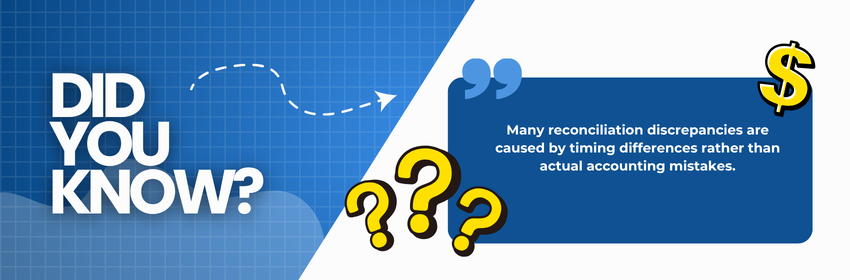
Reconciliation discrepancies take place when internal records do not get matched with bank statements or other supporting documents. Common causes of reconciliation errors include timing gaps, unfilled entries, manual errors, and unexpected fines. Regular reconciliation accounting helps teams identify differences before they are reported.
Timing differences in transaction recording
Timing differences reconciliation issues arise in case a payment, deposit, or cheque is recorded internally but reaches the bank after. Generally, month-end thresholds, weekends, holidays, and delays create irregular mismatches. While performing reconciliation accounting, these items are explained and carried forward.
Data entry errors & duplicate transactions
Reconciliation errors often begin with mistakenly typed figures, reversed digits, incorrect signs, or mistakenly placed decimals. Data entry errors in accounting reconciliation might involve duplicate entries caused by manual re-entry, overlapping feeds, or updates within the system.
Missing or unrecorded transactions
Missing transactions reconciliation accounting occurs only in case payments, invoices, receipts, or adjustments fail to appear in the ledger. Such types of reconciliation discrepancies leave balances incomplete and can continue into later periods when teams ignore supporting records.
Bank fees, interest & unauthorized charges
Bank reconciliation errors usually come when undocumented service fees, overdraft fines, charges, wire expenses, interest, or unauthorized transactions take place. Such a type of reconciliation accounting discrepancies should be quickly reviewed because some might need routine adjustments, while others may report weak controls or possible fraud.
Best Practices for Reconciliation Accounting
Strong reconciliation accounting best practices make it easier for reviewers to review and trust financial records. The objective is not only to match balances but also to identify errors before they occur, keep evidence organized, and create procedures that people can follow consistently. Account reconciliation best practices are practically combined with routine checks, fair ownership, useful paperwork, and technology.
Reconcile accounts on a regular schedule
According to account risk, transaction volume, and value, the reconciliation accounting frequency should be set. Cash, card, or high-risk accounts must be reviewed daily or weekly. In contrast, monthly reconciliation accounting is best for many balance-sheet accounts. As regular reviews stop small variances from becoming a month-end report issue, they also make investigation less rushed.
Maintain clear documentation for every reconciliation
Good reconciliation accounting documentation must describe which differences appeared, what was compared, and how each mismatch was resolved. Additionally, it maintains statements, invoices, adjustment entries, receipts, and reviewer suggestions together. Among the best practices, reconciliation teams should treat this record as a clear audit trail, as it saves plenty of searching later.
Segregate duties between recorders & reconcilers
Strong internal controls in reconciliation accounting demand involvement of different people to record transactions, approve corrections, and reconcile the balance whenever possible. Such separation of responsibilities adds another set of eyes and minimizes the possibility of mistakes or unauthorised entries going overlooked. It is considered one of the core best practices for account reconciliation teams.
Use accounting software to streamline reconciliation
Reconciliation accounting software uses matching procedures, imports records, highlights variations, and maintains approval traces. Businesses that automate reconciliation accounting reduce repetitive manual hard work and allow finance teams to focus more on unresolved issues.
Manual vs Automated Reconciliation Accounting
| Basis | Manual Reconciliation | Automated Reconciliation |
|---|---|---|
| Process | This staff compares statements, ledgers, and records sequentially. | Automated reconciliation accounting imports data, implements similar rules, and flags uncommon items. |
| Speed | Matching may take hours or days, especially near month-end. | Routine transactions clear quickly, helping teams close accounts sooner. |
| Accuracy and control | The outcome is based on manual entry and reviews, so manual errors can occur. | Standard rules improve consistency, while the audit trail is strengthened by time-stamped approvals and linked evidence. |
| Scalability and cost | It requires low software investment because of low transaction volumes, but labor demand rises as activity grows. | Automation requires complete setup, software costs, and training, and manages higher volumes without a similar increase in staff effort. |
Limitations of manual reconciliation accounting
Benefits of automated reconciliation accounting
How to choose the right reconciliation tool for your business
How Often Should Businesses Reconcile Their Accounts?
The answer to how often to reconcile accounts is based on the volume of transactions, business size, and level of fraud risk. A fixed account reconciliation schedule is stated below.
Monthly reconciliation — why it's the gold standard
Monthly reconciliation accounting is a standard form for many small businesses with stable or lower transaction volumes. It tracks the bank-statement cycle, keeps books up to date, and flags missing entries or duplicate payments before reporting.
Quarterly & annual reconciliation — when it works
Quarterly reconciliation accounting is suitable for accounts with minimal transactions. Annual reconciliation accounting works best for dormant or occasionally used accounts.
Real-time reconciliation — the future of accounting
Real-time reconciliation accounting methods match payments with invoices immediately after transactions arrive, rather than waiting for daily or weekly batches to arrive. This approach provides finance teams with an actual view of cash, reduces backlogs, and catches mismatches before they grow.
Why Your Business Needs Professional Reconciliation Accounting
Every business needs professional reconciliation accounting as it adds an independent check on its balances, figures, and records. Additionally, reconciliation accounting services compare statements, receipts, invoices, and ledger balances, then investigate suspicious activities. Outsourced reconciliation brings regular reviews and more transparent reporting for companies with limited capacity.
Catch errors & prevent financial fraud early
Duplicate payments, missing entries, altered amounts, and unexplained withdrawals are exposed by reconciliation accounting fraud prevention before they spread. Account reconciliation services create a regulatory layer and protect cash while making problems easier to trace.
Stay audit-ready & compliant year-round
Reconciliation accounting compliance is based on two components, including accurate balances and supporting evidence. Audit-ready reconciliation maintains statements, explanations, corrections, and approvals organized throughout the year. Hence, audit preparation does not feel like last-minute chaos.
Conclusion
We have learned that account reconciliation is more than just a regular finance task. It is a practical process through which you keep your figures accurate and your financial health stable. Routine inspections help you spot errors at an early stage, detect strange activity, and stop small issues before it becomes bigger concerns. Whether you run a business or handle personal finances, accurate and trustworthy records bring clarity and confidence to control. It is a smart way to check accounts and brings peace of mind.
Related Blogs



Common
Questions
Your Guide to Reconciliation Accounting...
Reconciliation accounting is a process of verification where an accountant identifies gaps, fixes errors, and maintains the reliability of statements.
Reconciliation accounting types are: Bank reconciliation, account reconciliation, and vendor & accounts payable reconciliation.
The answer to how often to reconcile accounts is based on the number of transactions, business size, and level of fraud risk. Ideally, accounts should be reconciled on a monthly, quarterly, and annual basis as per demand.
Bank reconciliation vs account reconciliation: Bank reconciliation is a procedure of verifying your internal cash records, and additionally, it matches your monthly bank statement. Reconciliation accounting is a broader aspect that includes accounts receivable and payable, and inventory. The process ensures that each figure is proven by supporting documents.
Timing differences in transaction recording, data entry errors & duplicate transactions, and missing or unrecorded transactions are the major causes of reconciliation errors.